You are reading this because you want insight that goes beyond surface impressions and online buzz. Maybe you have met someone from a Slavic culture. Maybe you are curious about cultural history and identity. Or perhaps you are a writer, scholar, or professional who wants reliable context instead of guesswork.
You are at the right place.
In order to truly understand Slavic women, you need to first understand what Slavic means. This term is used for the people who share not only the linguistic but also the cultural roots of Central and Eastern Europe and the Balkans.
Slavic women are from countries like Russia, Ukraine, Poland, Czech Republic, Slovakia, Belarus, Serbia, Croatia, Bulgaria, and many more, and Slavic women across these places share roots yet live very different lives. All these 15 or so nations have their own past, language, and customs but they still have some common threads that connect their cultural experiences.
Slavic women are a combination of myth, stereotype, and reality. Some depict them as only one type of character in the internet or in the media. There are some people who idealize or wrongly represent their characters.
Here is a preview of the topics we will cover:
- Origins of the Slavic people
- What defines Slavic culture and how Slavic women relate to it
- Appearance and individuality
- Relationships and family life
- Common misconceptions
- Modern roles in global society
- Cultural etiquette for respectful connection
- FAQs
How History Formed the Lives of Slavic Women
Origins of the Slavic People
The Slavic world has its origins with early Slavic tribes in the first millennium CE, and Slavic history continues to influence identity today.These tribes spread across large areas of Europe and later formed the identities of many Eastern European women and thus became the bases of several nations of the world.
The importance of geography cannot be underestimated here. You can trace the roots of the Slavs in Eastern Europe, Central Europe and the Balkans. The big countries with Slavic heritage are Russia, Ukraine, Poland, Czech Republic, Slovakia, Belarus, Serbia, Croatia, Bulgaria and many others.
Not only did history carve out the borders, it also determined the social roles. The Slavic societies were mainly agrarian. Life revolved around the land, families, and village communities. The men and women of these societies ate, lived, and worked within these structures thus their participation was influenced by them. Types of work were distinctly compartmentalized but also intertwined.
Women were in most cases the managers and organizers of the house and the family activities and at the same time they were producers in the farm and workers in the community as well. Working together and living off the land created the basis for the cultural traditions that were inherited in the following centuries.
Shared Traditions Across Many Nations
What Defines Slavic Culture
Slavic culture covers a large number of different countries, but there are certain things that you will find in all of them if you look carefully. One of the most important things for the family is their orientation. Kids are very much attached to their parents, grandparents, and other relatives, which reflects strong Slavic family values. Being hospitable is very important. Visitors are given what they need and more, and festivities are supported by the community and the food that is shared among them.
Religion has always been a major influence within Slavic culture and continues to shape how many Slavic women celebrate, gather, and mark life events. In majority of the Slavic countries, Christianity, particularly Orthodox and Catholic traditions, has been the main source of the celebrations and the way of life that was expected around life stages and festivals. Folk and seasonal rites, music, and dance reflect deep Slavic traditions that many Slavic women still celebrate today.
Values Often Associated With Slavic Women
Historically, Slavic and a great number of other societies based values on characteristics such as the ability to endure and the sense of community. These virtues were deeply rooted in the experience of suffering, revolutions, and common work. Nowadays, women in the Slavic countries are generally educated. Thus, scholarships, careers, and intellectual pursuits have become a normal part of life while the cultural heritage still being significant.
Resilience, dedication to education, and the ability to combine indomitability with gentleness are some of the qualities that are commonly referred to Slavic women. It is very important to understand these as characteristics rather than facts. Culture may set the standards, but individuals will always differ in how they express Slavic identity.
While culture had influenced the gender roles, todays life keeps changing the definition of women in any society.
Appearance And Style Without Stereotypes
Natural Beauty Traditions
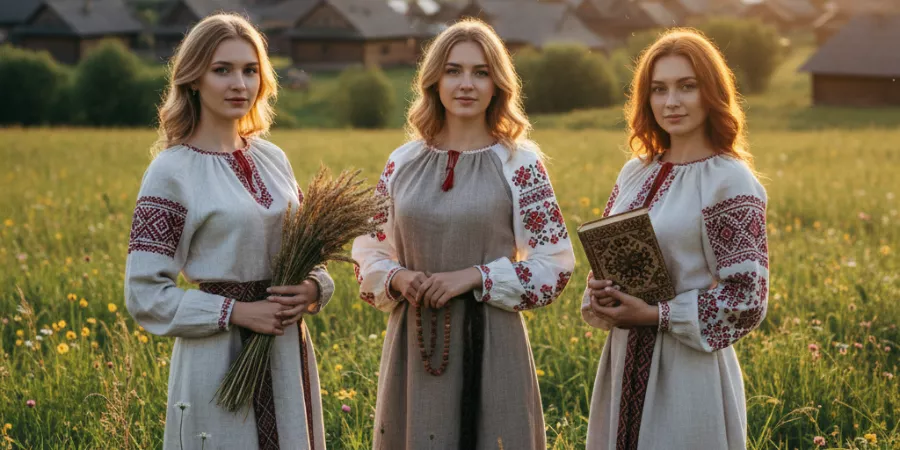
Several style elements across regions trace back to traditional Slavic clothing, local climate, history, and heritage of the areas. Usually, women are the ones who put a lot of effort in the way they present themselves. It can be that they are meticulous in their grooming, wear stylish clothing, or focus on the details.
However, the fact that there is diversity cannot be denied. It is not that every Slavic woman looks or dresses the same, and the first impressions differ greatly from one country and style of life to another.
Beauty standards are not the same in each region, and a great number of Slavic women choose to be different rather than to fit a certain stereotype. It is more important to emphasize individuality than to concentrate on one physical ideal.
How Slavic Women Approach Family And Partnership
Relationships, Family, And Social Dynamics
Strong commitment and loyalty to the family and partnership are among the most important things that are being pointed out in the majority of the Slavic cultures. It is not unusual for an extended family to continue having a role in daily life and making decisions. Marriage and long term partnership remain important for many, and this sense of commitment grows from deeply rooted Slavic family values, women inclusive, in a modern Slavic environment.
Modern Reality Versus Old Assumptions
The younger generations are reforming gender roles. Through education and career opportunities, many women are able to fulfill their personal ambition alongside family goals. The way of life in the city is usually quite different from that in the countryside, which shows how varied the modern Slavic lifestyle can be. Women may choose modern careers in cities while still honoring Slavic traditions that connect them to family and heritage, while at the same time they may continue to practice the family traditions.
The takeaway is simple. Identity continues to evolve. Tradition is still an important part of identity, but it is not completely dependent on it anymore.
Stereotypes that Need to Be Challenged
Common Misconceptions And Myths
There are old Slavic women stereotypes that deserve to be questioned instead of repeated. Some people depict them as passive or submissive. Others simply take their identities and place them in media tropes or fantasies. These notions are oversimplified and do not reflect the real people.
Why These Myths Exist
Stereotypes usually result from Western representations after the Cold War and from simplified views of Slavic history and from the absence of a well, developed cultural understanding. Media often simplifies identities into categories that are familiar, which can result in the characters of Slavic women and men being depicted to an exaggerated or even wrong extent.
People are different in any case, even if they share the same regional identity. That difference is the rule and not the exception.
Modern Slavic Women in Global Society
Education, Careers, And Independence
Today, Slavic women actively participate in various fields and are a significant force in nature. A considerable number of them are scientists, artists, educators, and business leaders. A few of them are the faces of the change in the political arena and international collaboration. They are the cultural ambassadors who, among other things, facilitate the development of cross, cultural understanding.
Concept of Gender in the Modern World
Contemporary Slavic females are pros at mixing old with new, they keep alive the past through present, day scholarship, writing, activism, and creative outlet. They are not the set of figures. Their goals and personalities develop in unique ways, influenced at times by Slavic heritage.
Cultural Etiquette And Awareness
If You Want To Learn More Or Connect Respectfully
Being curious and respectful matters. Avoid sweeping statements or assumptions. Learn about celebrations, histories, and local customs. Recognize that cultural pride is deeply meaningful to many people.
Practical Tips For Interacting Across Cultures
- Listen more than you speak at first.
- Learn key cultural celebrations and customs.
- Be sensitive about humor and topics tied to history or lived experience.
Empathy and humility are essential. Real understanding grows from listening and respectful exchange.
Frequently Asked Questions
What countries are considered Slavic?
There are ten countries that can be considered Slavic countries. They are Russia, Ukraine, Poland, the Czech Republic, Slovakia, Belarus, Serbia, Croatia, and Bulgaria.
Are Slavic women all similar culturally?
No, Slavic women are not all similar culturally. They have some traditions in common, but their cultural practices and everyday life differ greatly from one another.
Why do Slavic women value family strongly?
Being family, oriented is an aspect of the history and community life which is common to many of the Slavic cultures.
Are traditional gender roles still dominant?
While some traditions remain, there are more and more modern views on gender roles being adopted.
How has modernization changed expectations?
Through education and interactions with the world, more doors have been opened and identities have been changed for many people.
Conclusion
Slavic women are not the stereotypes people portray them to be. They are individuals who have their roots in the past, their lives influenced by their culture, and residing in a globe that is still changing. Knowing about the past, culture, and current identities is important because it allows one to see the real stories of people rather than the myths.
If you are willing to learn from history, art, and experience, then you should start with respect and curiosity. Genuine understanding is achieved through listening to and interacting with people the way they are, not how others perceive them to be.